
Rechercher...
Filtres sélectionnés
{{#data.error.root_cause}}
{{/data.error}}
{{^data.error}}
[{{{type}}}] {{{reason}}}
{{/data.error.root_cause}}
{{#data.hits.hits}}
{{#_source.featured}}
FEATURED
{{/_source.featured}}
{{#_source.showImage}}
{{#_source.image}}
 {{/_source.image}}
{{/_source.showImage}}
{{/_source.image}}
{{/_source.showImage}}
{{/data.hits.hits}}
{{{_source.title}}} {{#_source.showPrice}} {{{_source.displayPrice}}} {{/_source.showPrice}}
{{#_source.showLink}} {{/_source.showLink}} {{#_source.showDate}}{{{_source.displayDate}}}
{{/_source.showDate}}{{{_source.description}}}
{{#_source.additionalInfo}}{{#_source.additionalFields}} {{#title}} {{{label}}}: {{{title}}} {{/title}} {{/_source.additionalFields}}
{{/_source.additionalInfo}}-
ACTUALITÉS
- Recherche
- Manifestations scientifiques
- Appels en cours
- Parutions
- Institutions et facultés de droit
- Actualités des facultés de droit
- Les JPO
- Enseignement
- Actualités des formations
- Vie académique
- Concours, qualifications, recrutements
- Postes d'enseignants-chercheurs
- Postes d'ATER
- Emplois contractuels
- Emplois hors universités
- Rester informé
- Flux RSS & Canaux d'information
- Newsletter
-
-
FORMATION
- Diplômes juridiques
- Toutes les licences
- Doubles licences
- Licences internationales
- Parcours d’excellence
- Trouver un master
- Préparations aux concours
- Capacité en droit
- Se former à distance
- Formations professionnelles
- Licences professionnelles
- Diplômes d'université
- Formations courtes
- Orientation
- Le droit en terminale
- Les métiers du droit
- Structures de formation
- Facultés de droit
- Instituts d’études judiciaires
- IPAG
- Cliniques juridiques
- Instituts du travail
-
-
RECHERCHE
- Chercheurs
- Enseignants-chercheurs
- Docteurs en droit
- Structures d'appui à la recherche
- Laboratoires
- Ecoles doctorales
- Sociétés savantes
- Actualités
- Manifestations scientifiques
- Appels en cours
- Publications
- Ouvrages
- Les éditeurs juridiques
- La RHFD
- Disciplines juridiques
- Droit privé
- Droit public
- Histoire du droit
- Science politique
- Thèmes de recherche
- La recherche en accès ouvert
- Revues en libre accès
- Vidéothèque
-
UNJF
- Cours
- Cours en accès libre
- Accéder à la plateforme de cours
- Liste des cours en ligne
- Préparation du CRFPA
- Pix+ Droit
- L'Université Numérique Juridique Francophone
- Présentation
- Mettre en place une FOAD avec les cours UNJF
-
INSTITUTIONS
- Les facultés de droit
- Liste des facultés
- Actualités des facultés
- Les autres institutions
- IPAG
- IEJ
- Les institutions représentatives
- La Conférence des doyens
- Conseil national des universités
- La Conférence nationale du droit
- L'Association des directeurs d'IEJ
- La Conférence des directeurs d'IPAG
- Le portail univ-droit
- Présentation du portail
- La fondation Ius & Politia
- Les projets en cours
- Communication





5 030
enseignants-chercheurs
340 710
publications scientifiques
2 101
formations en droit
84
universités couvertes
Flux en direct
Manifestations
Tout voir →
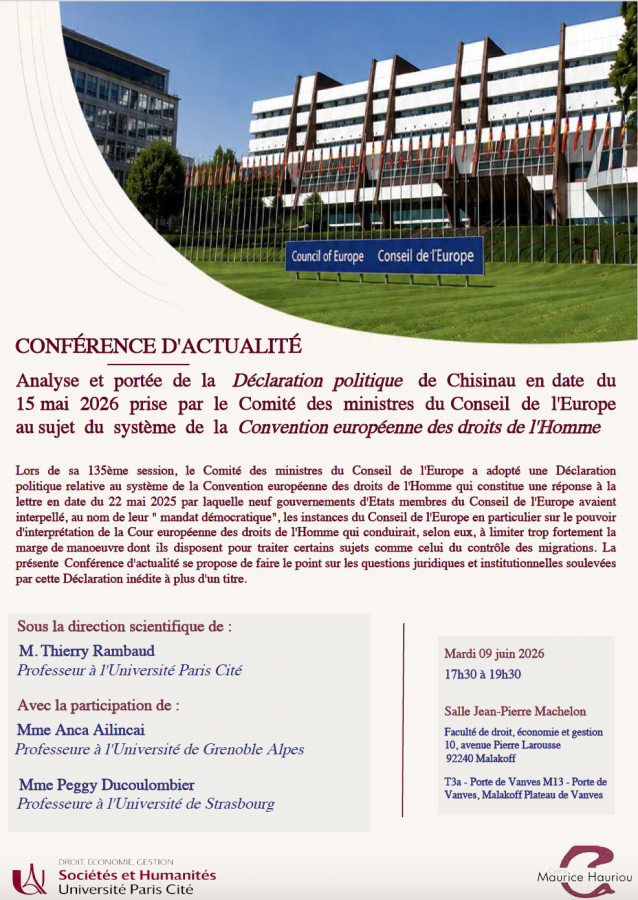
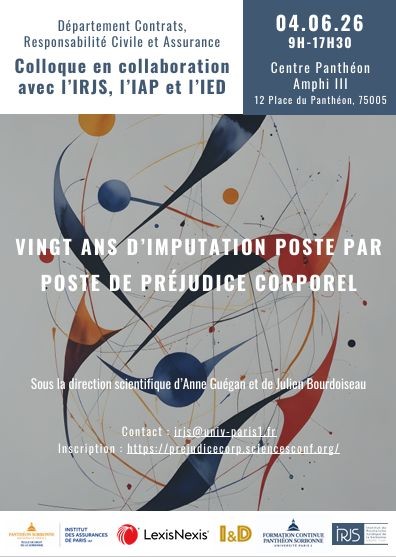
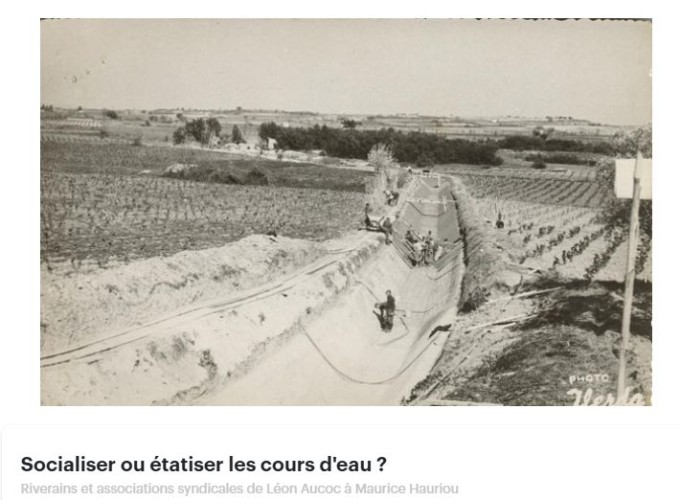
Droit et pratique des relations de travail à l’épreuve des systèmes d’intelligence artificielle
Le lobbyisme indirect : enjeux, stratégies et dimensions éthiques
Reconnaissance et réparations / Recognition and Reparations
Le contrat au service de l’internationalisation des entreprises
Coupe du monde 2026 : un terrain de jeu pour les droits fondamentaux ?
Appels à contributions
Tout voir →
La transmission normative
Nouvelles méthodes de guerre et nouvelles formes de conflictualité
Technologie, écologie et changements démographiques. Le travail face à la révolution digitale, climatique et à celle du "care"
Le droit hors-sol
Au-delà de la scène judiciaire : pour une approche spatiale de l’audience (Moyen Âge – Époque contemporaine)